
Academy
Cluster 07 / 08
AI SEO
Optimization for the engines that already answer half the queries Google used to own — ChatGPT, Gemini, Claude, Perplexity, and Google's own AI Overviews. The retrieval-and-citation discipline that decides whether your brand is in the answer set or invisible.
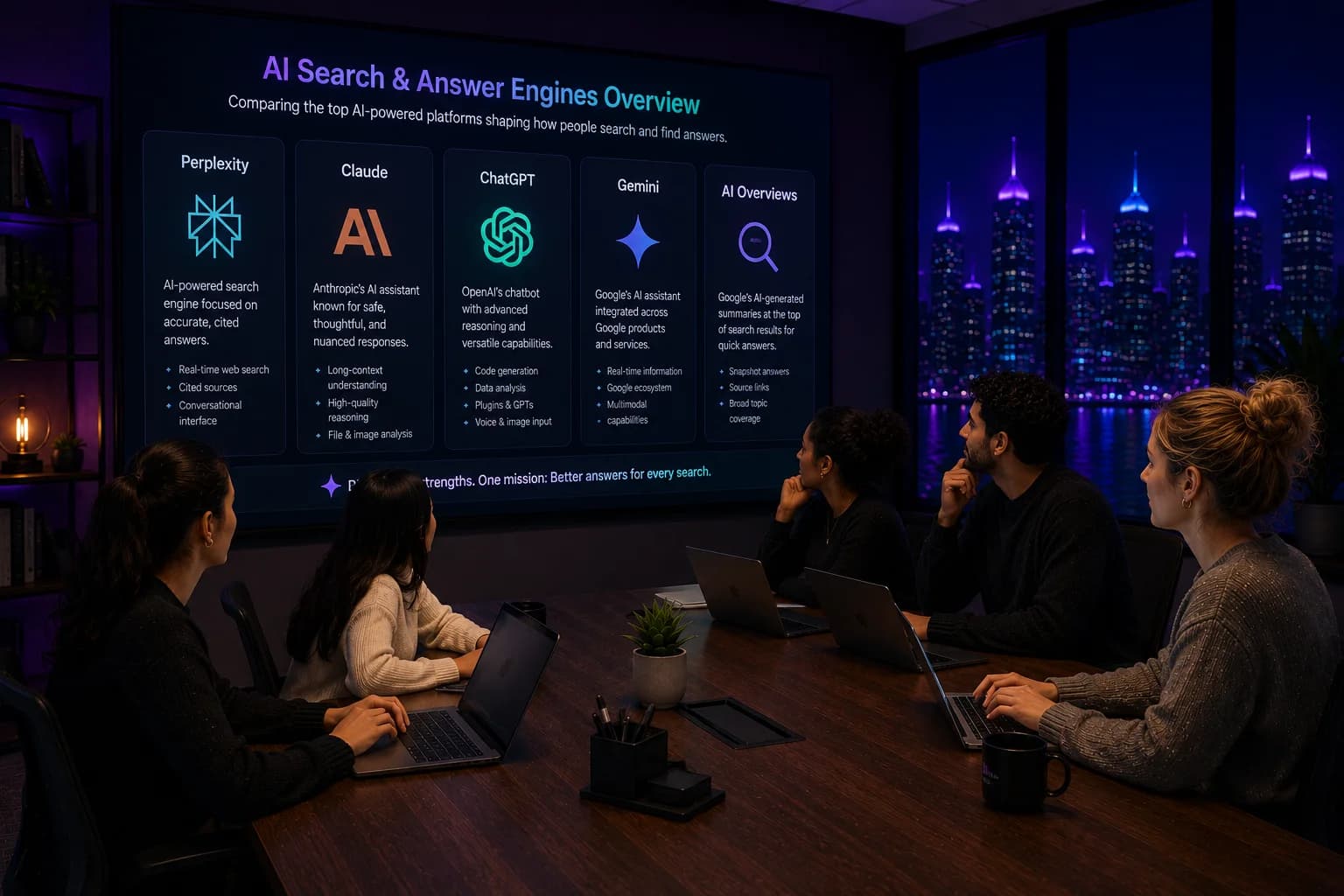
AI SEO is the optimization layer for engines that don't return ten blue links. They retrieve, summarize, and cite — and the citation set decides whether your brand is the answer or absent. ChatGPT, Gemini, Claude, Perplexity, and Google's AI Overviews each run their own retrieval logic, their own grounding sources, and their own preferences for which content earns a citation. The disciplines overlap with classical SEO but the optimization target is different: not a ranked URL, but a passage of text the engine quotes back to a user.
This is the AI SEO cluster — eight articles covering the engines and the techniques. The first chapter establishes how AI engines actually rank content (retrieval, embeddings, grounding, citation logic). The next five chapters walk through the dominant engines one at a time. The last two cover the cross-engine disciplines that decide whether you get cited at all: citation engineering at the passage level, and AI-search measurement so you can prove the program is working.
The compounding rule: AI engines reward depth, structure, and entity clarity. A site that ships answers, schema, and consistent entity signals across years compounds in citation volume the same way a classical-SEO site compounds in organic traffic. The discipline is new; the underlying physics — earn trust, structure information, get cited — is the same as it has been since 1998.
Articles in this cluster
Read in order, or jump to the chapter you need. Each article ends with a link to the next one.
- 01Chapter 01 of 08
How AI engines rank
Retrieval, embeddings, grounding, and citation logic — the four mechanics that decide whether a passage of your content ends up in an AI answer or never gets read at all.
9 min readRead chapter  02Chapter 02 of 08
ChatGPT optimization
The most-used AI engine in the world doesn't always cite — but it always reads. How to win brand mentions, citations when they exist, and the source preferences that decide whether ChatGPT reaches for your content.
8 min readRead chapter 03Chapter 03 of 08
Gemini optimization
Google's AI engine grounds in Google's own index — which makes it the most directly forecastable AI surface from organic SEO. Why what wins Google tends to win Gemini, and the tactical differences that still matter.
8 min readRead chapter 04Chapter 04 of 08
Claude optimization
The AI engine with the most conservative source weighting and the most thoughtful citation behavior — what Claude reaches for, what it skips, and how to be in the set when the user asks the careful question.
8 min readRead chapter 05Chapter 05 of 08
Perplexity optimization
The always-grounded, always-cited engine where new content surfaces fastest — and the closest thing to a measurable AI-SEO surface in 2026. What earns a Perplexity citation, and how to track when you're winning or losing it.
8 min readRead chapter 06Chapter 06 of 08
AI Overviews optimization
Google's AI summary inside the SERP — the highest-volume AI surface for most categories, the one that intercepts the click before the user reaches your page. What gets cited in the panel and how to win the cite without losing the click.
8 min readRead chapter 07Chapter 07 of 08
Citation engineering
The cross-engine discipline of designing content for passage extraction. Direct answers, named entities, schema confirmation, and the structural patterns that win citations across ChatGPT, Gemini, Claude, Perplexity, and AI Overviews simultaneously.
8 min readRead chapter 08Chapter 08 of 08
AI search measurement
How to track whether your AI-SEO program is working — across ChatGPT, Gemini, Claude, Perplexity, and AI Overviews. The metrics, the tools, and the methodology that turns AI search from a faith-based channel into an accountable one.
8 min readRead chapter