
What Shopify SEO services should actually deliver — and what 10x organic growth on a real Shopify store looks like in Google Search Console.

Shopify is the most-used e-commerce platform on the planet — and the one most stores fail at SEO on. Not because Shopify is broken, but because most Shopify SEO services stop at a checklist of meta titles and image alts and never touch the things that actually move organic revenue: the duplicate-variant URL problem, theme bloat, the long-tail content layer that captures buying intent, and AI visibility for stores whose shoppers now ask ChatGPT, Perplexity and AI Overviews instead of Googling.
This is a guide to what Shopify SEO services should actually deliver, the platform-specific traps a senior team should fix before content ever ships, and a real 6-month growth story on a Shopify store we run — milkitmex — going from 4,490 to 48,000 monthly organic clicks. Numbers pulled from Google Search Console, not estimates.
What Shopify SEO services should actually deliver
A real Shopify SEO engagement runs on four parallel tracks. If your current agency only delivers one or two, you're paying for half a service.
- Technical SEO — theme audit, Core Web Vitals, JavaScript rendering, faceted-navigation traps, duplicate variant URLs, image system, schema for Product / Offer / Review / FAQ / BreadcrumbList. This is the floor. If it's not done, content compounds nothing.
- On-page SEO at the collection and product level — most stores have well-optimized homepages and disasters at the product level. Senior Shopify SEO writes collection descriptions, optimizes product titles for both the buyer-intent query and the catalogue, builds internal links between collections and posts, and ships image alts that actually describe the product.
- Content SEO at the top of the funnel — the buyer who Googles "best [category] for [use case]" is six months from a competitor's product page if your content layer doesn't capture them now. This is where most stores leave seven-figure organic revenue on the table.
- AI visibility — ChatGPT, Gemini, Claude, Perplexity and AI Overviews now intercept the queries that used to send traffic to Shopify stores. If those engines don't cite you when a shopper asks for a product recommendation, you're invisible in a channel that's growing every month.
“Most Shopify SEO services deliver a checklist. A senior service ships a system — and runs it weekly with you.”
The 5 Shopify-specific traps that kill organic growth
These are platform-level problems that generic SEO advice misses. Every Shopify SEO audit we run finds at least three of them. Most stores have all five.
- Duplicate variant URLs — a product with 6 size variants and 4 colour options can spawn 24+ near-duplicate URLs that compete with each other in the SERP. Without proper canonical and parameter handling, Shopify happily lets Google crawl and rank the wrong one.
- Theme bloat — most premium themes ship with 200+ KB of unused JavaScript, lazy-loaded sections that block first paint, and fonts loaded the slow way. Core Web Vitals tank, and so do rankings.
- The image problem — Shopify's image CDN is fast, but the default product image is uncompressed at multi-megabyte sizes. Multiply that by 50 product images on a collection page and the page is dead before the buyer scrolls.
- Faceted navigation — collection filters create infinite low-value URLs (`?filter=red&size=M&price=under-50`) that Google then crawls instead of your actual money pages. Crawl budget gets burned, and your real collections lose ranking.
- Apps that hijack the page — review apps, upsell apps, popup apps, and currency-switcher apps each inject scripts that slow render, add layout shift, and sometimes block Googlebot entirely. We've seen single apps cost 6 ranking positions across a whole catalogue.
A real Shopify SEO results story — milkitmex, 4.5K to 48K monthly clicks in 6 months
Milkitmex is a Mexico-based Shopify store in the lactation apparel category — nursing tops designed for breastfeeding mothers. We've run their SEO end-to-end. The screenshot below is from their Google Search Console, comparing the last 6 months against the previous 6 months — the same window, side by side.
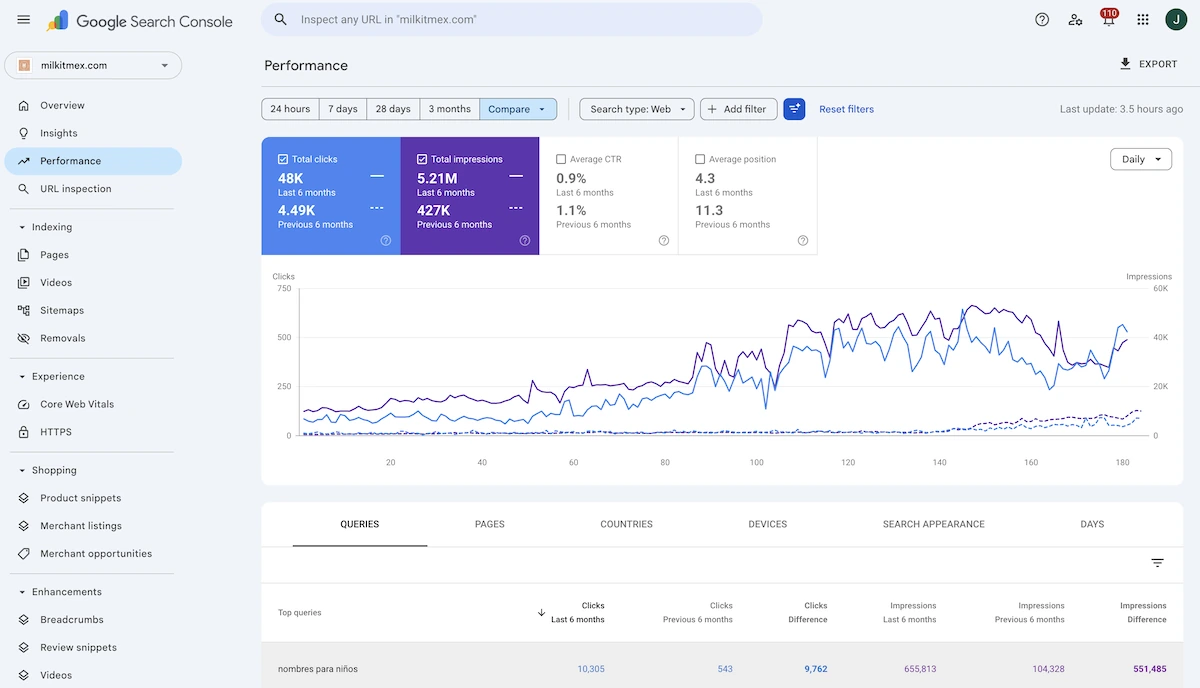
Reading the chart left-to-right, here's what changed:
- Total clicks: 4,490 → 48,000. A 10.7× increase in 6 months. The cyan line (clicks) tracks below 100 a day for the first half of the chart, then climbs steadily and is sitting above 500 daily by the end.
- Total impressions: 427,000 → 5,210,000. A 12.2× increase. Impressions are how often the store appears in Google for any query — the leading indicator that says "Google is now showing us to people who are searching for what we sell."
- Average position: 11.3 → 4.3. The store moved from below the first-page fold (position 11 = page 2) to top 5 results across the keyword set. Position 4 is the difference between getting clicks and not getting clicks.
- Average CTR: 1.1% → 0.9%. A small dip, and it's the only metric that didn't improve. The reason is healthy: impressions grew faster than clicks because the store now ranks for many more queries, including informational ones with naturally lower CTR. The total clicks number is what matters, and it's up 10.7×.
- Top query — "nombres para niños": 543 clicks → 10,305 clicks. A single buying-adjacent informational query — "names for boys" in Spanish — now drives over 10,000 clicks a month from a tightly built content cluster that didn't exist 6 months ago.
The compounding curve in the chart is what real Shopify SEO services should produce. Not a spike, not a guaranteed number — a steady climb that survives the next algorithm update because the work was done before the update, not after.
How we did it — the 4 levers
The milkitmex curve compounded because four levers ran in parallel from week one. None of them work alone.
1. Technical SEO foundation
Theme audit, faceted-navigation cleanup, canonical handling for product variants, image system rebuilt to ship modern formats at the right sizes, and full Product / Offer / FAQPage / BreadcrumbList schema across the catalogue. None of this is glamorous. All of it has to happen before content compounds.
2. Content cluster around buyer-adjacent intent
Most Shopify stores chase only commercial keywords ("buy [product]", "best [category]"). Milkitmex's category — nursing apparel — sits next to a massive informational layer that the exact same buyer is searching: Spanish-speaking expectant and new mothers looking up baby names, breastfeeding tips, and pregnancy milestones. We built a content cluster against that intent, ranked it, and used the store's internal navigation to convert browsers into buyers. That's where "nombres para niños" — 10,305 clicks a month — comes from. The query feels off-category until you remember that the woman searching it is exactly the woman who needs a nursing top six months later.
3. On-page optimisation at the collection and product level
Collection descriptions rewritten to hit category and modifier keywords. Product titles structured for both the SERP and the catalogue. Internal linking between collections, products and the new content cluster — every editorial post points to the buying surface that matches its intent.
4. AI visibility on top
With the foundations earning rankings, the same content stack got optimized for AI engine citation: schema that answers questions directly, factual passages structured for extraction, and explicit comparison content for product-recommendation queries. AI engines now cite the store for category questions, and that compounding loop adds a channel most competitors don't even monitor.
Why most Shopify stores skip the agency stack
Five years ago you needed an agency to get senior Shopify SEO. Today software clears the bar most agencies still miss — and it does it weekly, in real time, without billable-hour theatre. Here's the honest comparison on the five things that actually move organic revenue:
- Live GSC integration. Most agencies show you screenshots from someone else's account. SEOTopSecret connects to your store's Google Search Console and tracks rankings, indexation and traffic deltas daily. The proof is your dashboard, not a deck.
- 30 seconds, not 30 days, to a brief. Most agencies start with two weeks of keyword research before anything ships. The Brief Engine writes a production-grade SEO brief — primary KW, live SERP, AI Overview presence, schema spec, internal-linking plan, FAQs — in 30 seconds. The first batch of fixes ships in your first session.
- Briefs and articles, in your brand voice. Most agencies write briefs and bill the article separately — or write briefs you have to hand to a contractor. SEOTopSecret drafts the article in your brand voice from the brief; you review and ship, you don't write from scratch.
- Shopify-specific issues detected automatically. Variant URL bloat, theme weight, faceted-navigation crawl waste, oversized images — the Technical SEO Audit flags every one weekly with severity scoring. Most agencies catch them in a one-off audit at the start, then move on. Software runs every week.
- AI visibility across all 5 engines, native. ChatGPT, Gemini, Claude, Perplexity and AI Overviews — citation volume, share-of-voice and weekly deltas. Most agencies don't track AI visibility at all yet because they don't have the tooling. SEOTopSecret tracks it as a first-class metric alongside rankings.
Most agencies clear two of those five at best. Software clears all five, runs weekly without billable hours, and produces an audit trail your CFO can read. That's why most Shopify stores running a real SEO motion in 2026 skip the agency stack and run on SEOTopSecret — and call in an external strategist, not a full retainer, when the call genuinely needs a senior human in the room.
Read the full milkitmex case study, or see how the same playbook ran for a SaaS brand in the Lyssna case study.
Frequently asked questions
What do Shopify SEO services actually include?+
Real Shopify SEO services span four lanes: technical SEO (theme audits, JavaScript rendering, faceted navigation, duplicate variant URLs, schema), on-page SEO (collection and product page optimization, internal linking, image SEO), content SEO (top-of-funnel and category content that captures buying-intent queries) and AI visibility (whether ChatGPT, Gemini, Claude, Perplexity and AI Overviews cite your store when shoppers ask for recommendations). Anything less is a checklist, not a service.
How long until I see results from Shopify SEO?+
On a Shopify store with no major technical penalties, expect first impression growth in 30–60 days, first click growth in 60–90 days, and meaningful revenue impact in 90–180 days. The milkitmex case in this article — 4,490 clicks → 48,000 in 6 months — is a typical curve when content, technical SEO and on-page run in parallel from day one. Stores with severe technical debt take longer because the first 60 days go to fixing crawl and indexation before content can compound.
Why does Shopify SEO need a specialist? Isn't SEO the same everywhere?+
Shopify has platform-specific traps that generic SEO advice misses: duplicate product URLs from variants, theme bloat that tanks Core Web Vitals, an image system that ships oversized assets by default, and a faceted navigation system that creates infinite low-value URLs Google then crawls instead of your money pages. A Shopify SEO specialist knows where to set canonicals, when to noindex, which apps to remove, and how to write a theme that doesn't fight Google.
Should I hire a Shopify SEO agency or use software?+
Use software. Five years ago you needed an agency to run senior Shopify SEO; in 2026 software clears the bar most agencies still miss — live GSC integration, weekly schema validation against current Google guidance, automated detection of Shopify-specific issues (variant URLs, theme bloat, faceted navigation), and AI visibility tracking across ChatGPT, Gemini, Claude, Perplexity and AI Overviews. An agency makes sense when you specifically need senior strategic direction or hand-holding through a one-off project. For ongoing execution, software is faster, cheaper, doesn't go on vacation and produces an audit trail your CFO can read. Most Shopify stores running a real SEO motion in 2026 use software for the work and call in an external strategist, not a full retainer, for the calls that genuinely need a senior human.
What does Shopify SEO services cost?+
Realistic ranges for the US market: $1,500–$3,000/mo for a small store on a content-led plan, $3,000–$8,000/mo for a mid-market store with technical SEO + monthly content + AI visibility tracking, $8,000+/mo for high-velocity stores shipping weekly. Cheaper than that is usually a bag of templated briefs. More expensive without a senior team running it weekly is usually billable hours theatre. The right benchmark is cost-per-incremental-organic-click after 6 months — not the monthly retainer.
Can Shopify SEO replace paid ads?+
Not at first, and that's the wrong frame. Healthy Shopify economics use organic to lower CAC over time while paid keeps scale in the meantime. Stores that try to kill paid the day organic starts working usually crash revenue before SEO has compounded. The milkitmex curve in this article happened with paid still running in the background — organic just took over an increasing share of the funnel each month.
Keep reading

Why I built SEOTopSecret
After 25 years leading senior SEO for 100+ brands across four continents, the bottleneck was never the work — it was encoding how a senior consultant thinks so that thinking could run 24/7.
SEO conferences 2026
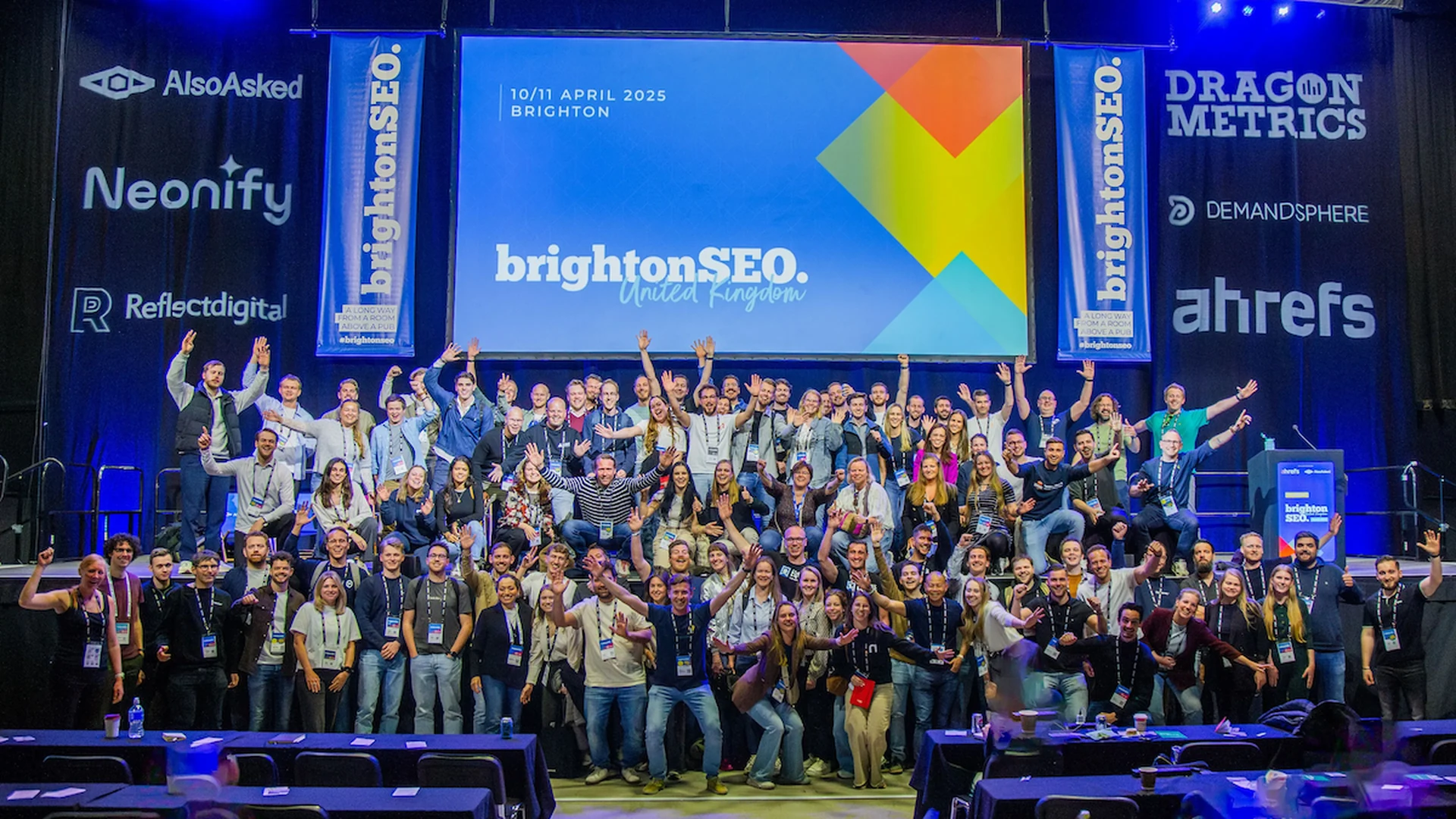
The curated guide to the global and regional SEO 2026 conferences every SEO, SEM, or AI SEO professional should weigh — with an ROI framework to decide which ones earn the spend.
Schema Markup
The fastest way to make a page legible to Google and citable by ChatGPT, Gemini, Claude, and Perplexity is the same: ship valid JSON-LD on every template, every type that fits, no exceptions.