
Local SEO
Chapter 05 / 08
Reviews and reputation management
The single largest prominence signal in local SEO — count, recency, rating, and the response cadence that turns reviews into ranking lift instead of overhead.
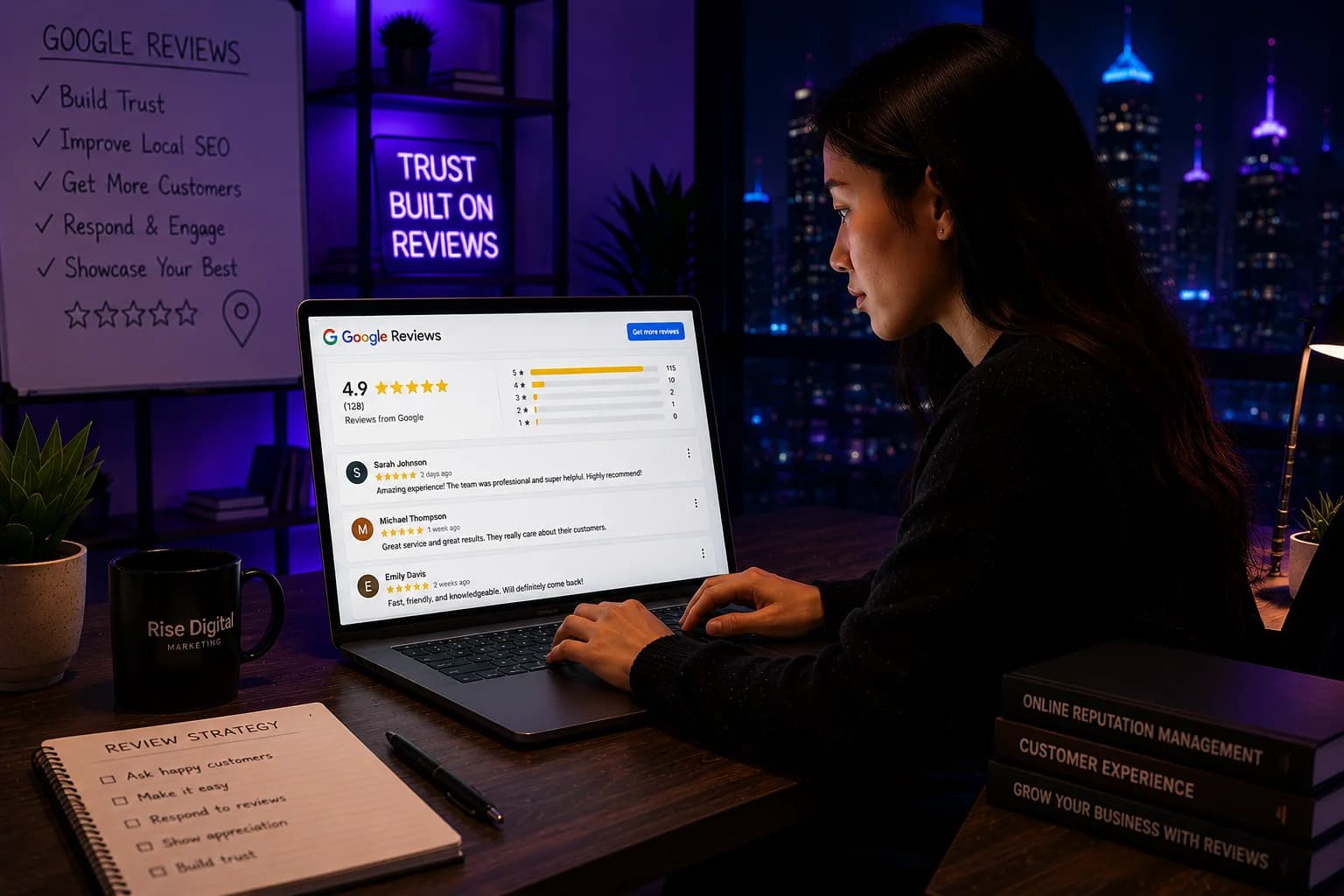
Reviews are the dominant prominence signal in local SEO. They feed the map pack, they convert clicks into bookings, they surface in AI search summaries, and they propagate to every aggregator that pulls from the GBP. A business that does the rest of the local-SEO stack but neglects reviews caps its ranking growth around the median; a business that operates a disciplined review program — request, response, recency — overtakes structurally larger competitors within 12–18 months. This chapter covers the operational discipline.
“Reviews are the only signal in local SEO that scales with operational quality. Every other signal — categories, schema, citations — is a one-time setup with maintenance overhead. Reviews are produced every week, by every customer interaction, and the ranking lift compounds over years.”
What Google actually weighs
Three dimensions, ranked roughly by weight in the map-pack algorithm:
- Recency. A profile with reviews coming in every 1–2 weeks signals an active, operating business. A profile where the last review was eight months ago signals stagnation, regardless of the historical count. The 90-day window matters most.
- Count. The total review count establishes the prominence floor. Below 10 reviews, a profile is barely visible in competitive map packs. 50 reviews is the start of competitiveness for most categories. 200+ is the entry point for top-3 in urban competitive categories.
- Rating. Average star rating moves the floor and ceiling. Above 4.3 is the competitive band; below 4.0 is a structural ceiling that limits ranking even with high count.
Two secondary dimensions:
- Review content keywords. Reviews that mention specific services or category-defining terms feed the relevance pillar in addition to prominence. "Best deep-dish in town" carries a category-relevance signal beyond the rating.
- Owner response rate and cadence. Profiles where the owner consistently responds within 7 days have higher engagement and slightly better ranking, likely via the engagement signal feeding back to prominence.
The request workflow
A review program that compounds is built on operational triggers — moments in the customer journey where a review request is natural and contextually appropriate. The template by business type:
- Service businesses (plumber, electrician, contractor). Trigger the request at job completion, before the technician leaves the property. The completed-work moment is the highest-converting review window — the customer is satisfied, the work is fresh, and the technician's presence creates social pressure to follow through.
- Restaurants and food service. Trigger at the bill or check-out moment. A short URL or QR on the receipt generates 3–5x the response of a follow-up email two days later.
- Healthcare and professional services. Trigger at the post-appointment check-out, with a follow-up text 24 hours later for those who didn't act on the first prompt. The follow-up pulls in 30–40% additional response.
- Retail. Trigger at point-of-sale (receipt + verbal request from staff) for in-store; trigger via post-purchase email 48 hours after delivery for online-buy-online.
- Service-area home services. Same as service businesses, with an extra friction-reducing step: the technician walks the customer through opening the GBP review form on their phone before leaving. Removes the largest dropout point (customer can't find the profile later).
The response template
Owner responses are visible to every future searcher and contribute to the brand impression more than the review itself. The structure that works for both positive and negative:
- Address the reviewer by first name. Specific, personal, signals attention. "Thanks, Sarah" beats "Thanks for the review."
- Reference a specific detail from the review. Quote something they said. Proves you read it; signals to readers that you read all of them.
- For positive reviews: add a sentence that subtly reinforces the brand — a service the reviewer didn't mention, a hours note, a future visit invitation. The response is also marketing copy.
- For negative reviews: acknowledge the issue specifically (not generically), state what was done or will be done, offer a private channel for resolution. Do not argue, do not explain at length, do not blame the customer. The response is performative for future readers as much as the original reviewer.
- For neutral or 3-star reviews: often the highest-leverage to respond to, because the review reads as cautious. A specific, helpful response that addresses the lukewarm point converts the reader's read of the review.
Negative reviews — handling without escalating
Negative reviews are inevitable. The wrong response makes them worse; the right response often pulls the rating back up because the review system shows owner engagement to all readers.
- Do not respond emotionally. Walk away for an hour. Drafting in the heat of the moment is the most common cause of public escalation.
- Do not name accuse the reviewer. Even when their account is wrong, a calm response that doesn't accuse them of lying lands better with future readers. Future readers always side with the reviewer when the response is hostile.
- Do offer a specific resolution. "Please call us at [phone]" beats "We'd love to make this right." Specific is credible; generic is corporate-sounding.
- Do flag clearly fake reviews. If the review is from a competitor, ex-employee, or names a service you don't offer, flag it via Google's review management. The flag rate isn't 100% but it's the only path.
- Do follow up offline. If you resolve the issue privately, ask the reviewer if they'd consider updating the review. Many will. The before/after is visible to readers and signals operational quality.
Review quality vs review volume
A review that says "great service" with 5 stars is worth less than a review that says "Carlos was on time, fixed the leak under the sink in 20 minutes, and didn't charge for the diagnostic. Will use again." The second review carries entity associations (technician name, specific service, pricing trust) that feed the relevance pillar in addition to prominence.
The implication: review prompts that ask for specifics outperform generic prompts. Instead of "How was your experience?", ask "Which service did we provide and what did you think?" The responses are more useful, more specific, and earn more weight.
Cadence and operational rhythm
The minimum viable cadence for a competitive review program:
- Weekly: respond to every new review (positive and negative). Scan for fake or policy-violating reviews and flag them.
- Monthly: review the review-request funnel — open rate of the SMS or email, click-through to the GBP, completion rate. A drop in any step shifts focus.
- Quarterly: audit the rating distribution. A sudden cluster of 3-star reviews signals an operational issue worth investigating.
- Annual: compare review velocity to competitor velocity. If a competitor is pulling 5x more reviews per quarter, the gap will become structural in 18 months.
Cross-platform reputation
GBP reviews carry the most weight for map-pack ranking, but the broader reputation signal includes Yelp, Apple Maps, Facebook, and category-specific platforms (Healthgrades, OpenTable, etc.). AI engines pull from all of them. The hierarchy:
- GBP first. The single biggest impact on local ranking.
- Yelp + Apple Maps next. Apple Maps surfaces Yelp reviews directly; a Yelp investment lifts both.
- Category-specific platforms third. Trust dominance for high-stakes categories (medical, legal, financial). For these categories, the category-specific platform may carry equal or greater weight than GBP for trust purposes.
- Facebook last. Lowest weight in algorithmic ranking but high in word-of-mouth amplification.
With reviews under operational discipline, the relevance and prominence pillars are both moving. The next chapter, local on-page and schema, returns to the website itself — the on-page work that turns the GBP relevance signal into compounding ranking lift.
Common questions
Common questions
Quick answers to what we get asked before every trial signup.
There's no fixed number — it's relative to competitors. The top 3 in the map pack for a competitive urban category typically have 200+ reviews each; in a less-competitive suburban category it can be 30+. The relevant question isn't your absolute count, it's the ratio of your count to the top 3 you're trying to displace. As long as you're at 60–70% of the top competitor's count and your recency is fresher, the ranking gap closes.
In this cluster