
Local SEO
Chapter 01 / 08
Google Business Profile
The single property that decides whether you appear in the map pack at all — how to claim, verify, optimize, and operate a Google Business Profile that actually wins local intent in 2026.
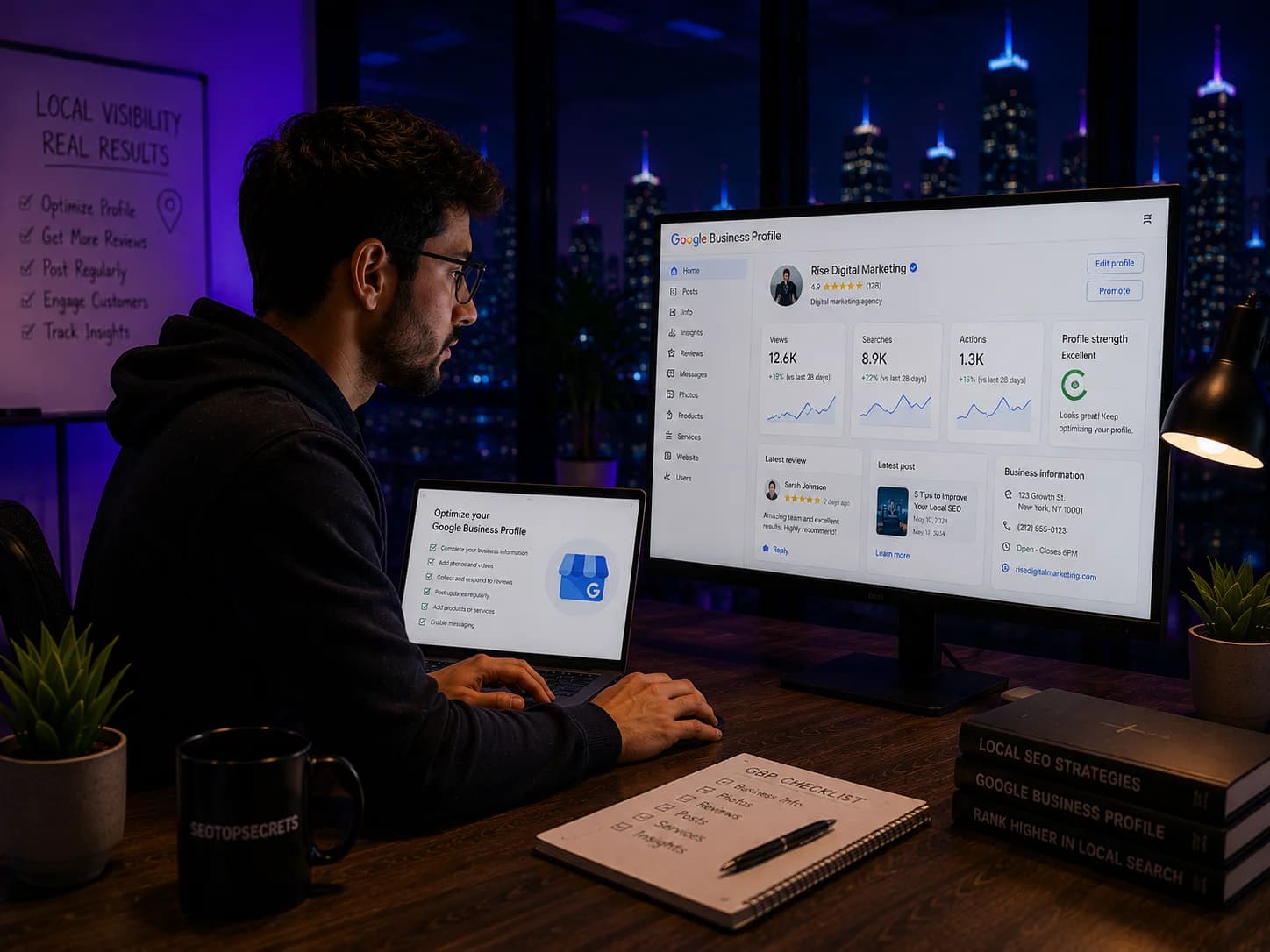
Local SEO has one foundation property: the Google Business Profile. Every other signal in this cluster — citations, reviews, local keywords, schema, multi-location architecture — feeds into or is read against the profile. A business without a verified, optimized profile cannot rank in the map pack, regardless of how strong its organic presence is. A business with a sharp profile can dominate local queries even when its broader site is mediocre. The asymmetry is bigger here than in any other discipline.
“The map pack is a separate ranking system. Your top-three organic position doesn't translate; your domain authority doesn't transfer. The map pack reads your Google Business Profile, your citations, your reviews, and your proximity to the searcher, and ranks against those signals alone. If you're not in the candidate set the map pack draws from, you're not in the conversation — and the candidate set is built from one property: the profile.”
Claim and verify
Claiming is free and starts at business.google.com or directly from the search results when the business already has an unclaimed listing. Most established businesses already have an auto-generated profile from public data, web crawl, or user-submitted edits — claiming attaches your owner identity to the existing record rather than creating a new one. Always claim the existing record when present; creating a duplicate splits the citation graph and forces a manual merge later.
Verification is the gatekeeping step. Google chooses the verification method based on category, country, and risk profile — you don't get to pick. The most common methods in 2026:
- Video verification. The dominant method now. Record a short walkthrough showing the exterior signage, interior, branded equipment, and proof of business operation. 24–72 hour review.
- Postcard. Still issued for some categories. A code mailed to the business address; enter the code to verify. 5–14 days.
- Phone or email. Offered for low-risk categories or when the business has prior verified history. Near-instant.
- Bulk verification. For chains with 10+ locations under one corporate owner. Submit a spreadsheet + corporate proof; Google verifies all locations at once.
Primary category — the highest-leverage decision
The primary category is the single biggest relevance signal in the map-pack algorithm. It's also a one-shot decision: changing it later resets some accumulated signal and triggers re-evaluation against competitors who didn't change theirs.
The rule: pick the most specific category that accurately describes what you sell most often. A specialty coffee shop should be "Coffee shop", not "Cafe" or "Restaurant". A pediatric dentist should be "Pediatric dentist", not "Dentist". The narrower the category, the less competition for the queries that match it, and the more relevance you accumulate per impression.
Secondary categories help but with diminishing returns. Three to five secondary categories is the practical ceiling — beyond that you dilute the primary signal. Use them to capture adjacent queries the primary doesn't already cover.
NAP, hours, and service area
Name, Address, Phone (NAP) is the canonical identity that propagates to the citation graph — Yelp, Apple Maps, Bing Places, industry directories, all read from this record. Inconsistent NAP across the web is one of the top causes of local-pack suppression because Google can't confidently match the entities. Get the profile NAP exactly right before any citation work begins; the chapter on NAP consistency and citations covers propagation in depth.
- Business name. The legal or operating name only. Adding city, category, or keywords ("Joe's Plumbing — Best Plumber in Boston") is a policy violation and triggers suspension when reviewed.
- Address. The exact street address as it appears on utility bills and lease documents. Suite numbers go in the second address line, not the first.
- Phone. A local number with a real area code, not a national 1-800. Local phone is a relevance signal; toll-free numbers weaken it.
- Hours. Special hours for holidays, closures, and seasonal changes must be set in advance. A profile that says "open" when it's closed gets review penalties and visibility hits.
- Service area. For service-area businesses (plumbers, mobile dog grooming, in-home tutoring), set the service area cities and hide the physical address. Address-suppressed profiles are a separate category and treated correctly by Google as long as the service area is set.
Attributes, services, and products
Attributes are the structured data Google uses to filter local results. "Outdoor seating", "Wheelchair accessible", "Black-owned", "Online appointments" — every attribute is a query filter that pulls qualifying businesses into a smaller candidate set. Filling out every applicable attribute is one of the highest leverage uses of the first hour with a new profile.
Services and products are free-text fields with categories. Use them to load up the relevance signals: every service line you add is keyword-matched on relevant queries, and services with descriptions outperform services without them in the relevance scoring. Don't keyword-stuff — Google's review queue strips obvious abuse — but be specific. "Tooth extraction (wisdom teeth)" beats "Extractions"; "Same-day plumbing repair" beats "Plumbing".
Photos — the most under-invested signal
Photos are the single most under-invested area on most Google Business Profiles, and the highest-impact one for engagement. Profiles with 100+ photos see significantly higher click-through, request-direction, and call rates than profiles with the default 5–10. Three rules:
- Cadence over volume. Twenty new photos uploaded over 12 weeks beat 100 photos uploaded in one batch. The freshness signal weights recent uploads.
- Owner-uploaded vs customer-uploaded. Both contribute. Owner-uploaded sets the curated baseline; customer photos validate it. Encourage reviews-with-photos to drive the customer side.
- Geotag and label correctly. Photos uploaded with EXIF location data and named descriptively (not "IMG_2847.jpg") contribute slightly more to relevance.
Posts and Q&A
Posts are short updates that surface in the right-hand panel of the profile and the map pack interactions. Treat them as weekly micro-content: an offer, an event, a new product, a milestone. Posts roll out of the public profile after seven days but stay in the relevance engine longer; cadence is what compounds.
Q&A is community-edited but owner-influenced. Anyone can ask a question and anyone can answer; if the owner doesn't seed answers, customers and competitors will fill the void. Pre-populate the top 10 questions you'd expect customers to ask, write owner-marked answers, and check weekly for new community questions. Unanswered questions are visible to every searcher viewing the profile and erode trust silently.
The operational rhythm
A profile that earns the top of the map pack is operated, not optimized once. The minimum viable cadence:
- Weekly: one post, one new photo, scan Q&A for new questions, scan reviews for new responses needed.
- Monthly: review insights (search queries, calls, direction requests, photo views), audit attributes for new options Google may have added, refresh services/products text if anything changed.
- Quarterly: review the primary category against the top three queries you target, check NAP against citation sources for drift, audit hours including upcoming seasonal changes.
That cadence is the operational floor. The next chapter, local search ranking factors, breaks down the proximity-relevance-prominence model the algorithm uses to score everything described above.
Common questions
Common questions
Quick answers to what we get asked before every trial signup.
Yes — Google renamed Google My Business to Google Business Profile in late 2021 and retired the standalone GMB app in 2024. The product is now managed directly from Google Search and Google Maps when you're signed in as the business owner. The functionality is identical to what most teams remember as GMB; the brand and entry points changed.
In this cluster
Local SEO
- 01
Google Business Profile
Reading now
02. Local search ranking factors
Upcoming
03. NAP consistency and citations
Upcoming
04. Local keyword research
Upcoming
05. Reviews and reputation management
Upcoming
06. Local on-page and schema
Upcoming
07. Multi-location local SEO
Upcoming
08. Map pack optimization
Upcoming