
International + Specialized
Chapter 04 / 08
International link building
Why a perfectly localized site still doesn't rank in the target market without local backlinks — and the per-region link strategies that build the trust signal Google uses to verify a brand actually belongs in the country it's targeting.
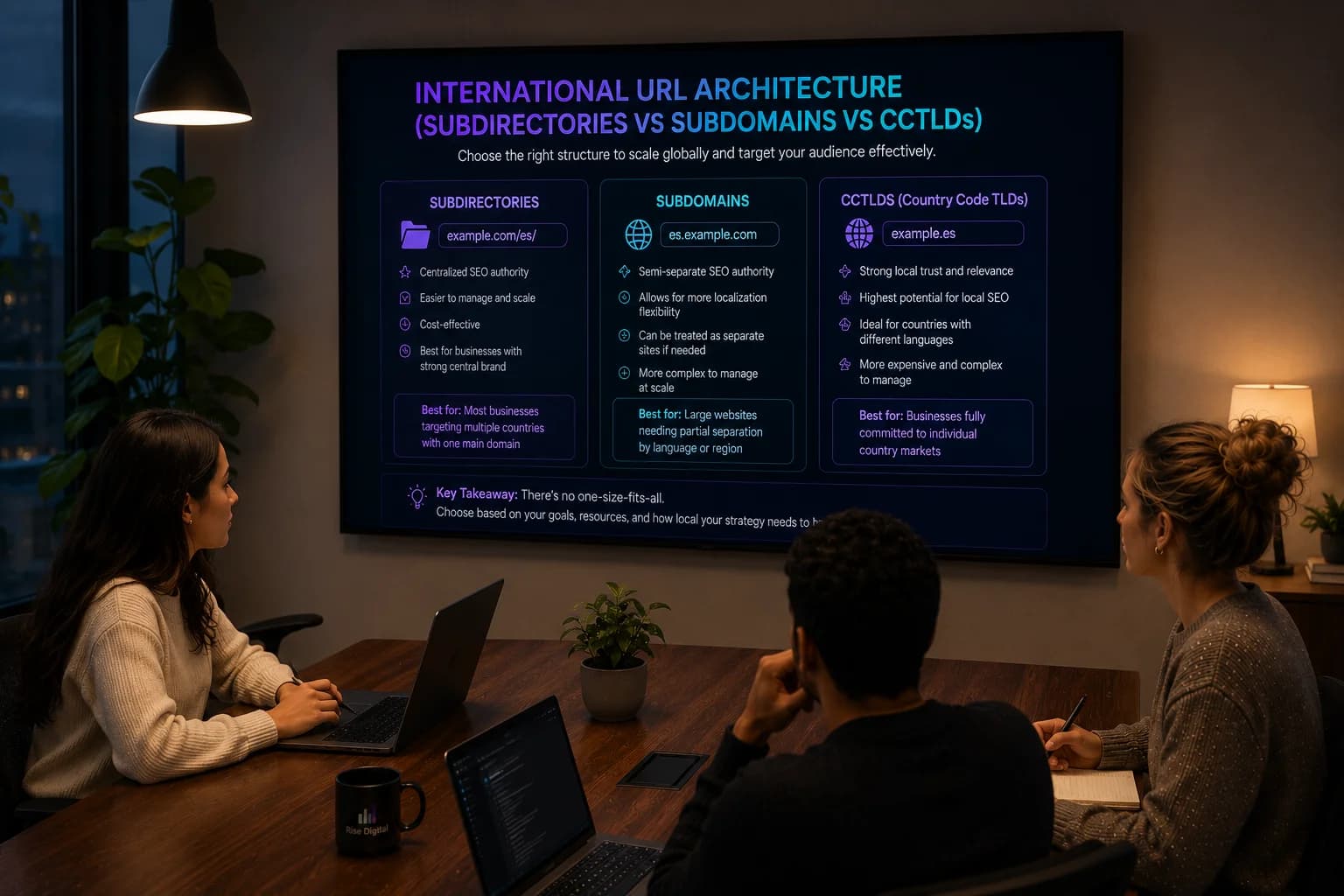
International SEO has a quiet failure mode: a perfectly localized site, flawless hreflang, region-targeted content — and rankings that still trail local competitors. The cause is almost always the same: the site lacks per-region backlinks. The standard global link profile gets the brand into the candidate set; the local link profile is what wins the rankings against locally-rooted competitors. This chapter covers the patterns that build per-region authority and the operational model for scaling the work across multiple markets.
“A localized site without local backlinks is half an international SEO program. Hreflang and translation get you on the field; per-region link profile is what wins the matches. The off-page layer is the part most international programs skip — and the part that most differentiates the winners from the also-rans.”
What "local" means for a backlink
Three signals make a backlink "local" for international-SEO purposes:
- The linking domain's TLD. A .mx domain is local to Mexico; a .com.au is local to Australia; a generic .com depends on its content and audience.
- The linking domain's content language and topical focus. A .com domain that publishes in Spanish about the Mexican market reads as locally-relevant even without a .mx TLD.
- The linking domain's audience. A site whose traffic and citations are concentrated in the target country signals locality regardless of TLD or language.
The strongest local backlinks combine all three: a .mx domain, publishing in Spanish, with primarily Mexican audience. The mid-tier mixes some signals — a .com domain that focuses on the Mexican market still carries local weight. The weakest signal: a generic .com with no per-country focus and a global audience.
Per-region link patterns
- Local press coverage. Coverage in regional news outlets, industry publications, and trade press. The highest-trust local link source for most categories.
- Local industry directories. Trade associations, industry bodies, regional business directories. Lower per-link weight but cheaper to acquire and they reinforce the geographic signal.
- Local partner sites. Local distributors, integrators, agencies, resellers. These accumulate naturally as the business operates in a market.
- Local sponsorships and event listings. Sponsoring a regional conference produces a sponsor logo + link on the event site, plus secondary citations in recap content.
- Local academic and government sources. .edu equivalents and .gov equivalents in the target country. High trust, hard to acquire, often through partnerships or research collaboration.
- Local data and research distribution. A localized data drop — research with country-specific findings — gets covered by local press and creates link velocity in the target market.
The localized data-drop pattern
Original research scoped to a specific country produces the highest link velocity per dollar in international link building. The pattern:
- Run an analysis that produces country-specific findings (Mexican consumer behavior, Australian market trends, Spanish industry benchmarks).
- Publish the data on the localized URL (example.com/es-mx/research/...). Hreflang routes the right audience.
- Pitch the data to country-specific industry press, business outlets, and trade publications.
- The press coverage produces local backlinks pointing at the localized URL — exactly the signal needed for the localized URL to rank in-country.
One country-specific data drop typically produces 15–40 local backlinks over 60–90 days. The chapter on digital PR for SEO in the off-page cluster covers the methodology in depth; the international application is the same playbook scoped per market.
The operational model for multi-market outreach
Building links in one market is a project; building them in 5+ markets simultaneously is an operations problem. Three patterns:
- Per-market PR partner. Contract a small PR or content agency in each major target market. They handle outreach, pitch in language, and have established relationships. Per-market cost: meaningful but predictable.
- Centralized outreach with localized assets. Centralize the outreach team but localize the assets (data, quotes, examples) per market. Works for English-speaking markets where one team can manage UK/US/AU; harder across language boundaries.
- Hybrid. Centralized strategy and asset production; per-market PR partners for execution. Most common pattern for mid-to-large international programs.
What doesn't work
- Buying links from low-quality regional directories. The directory networks that sell .mx, .com.au, .co.uk links are the same networks Google de-weights. Quantity without quality.
- Translating press releases for distribution. Translated press releases land flat in local press because they're framed for a different market. Localize the angle, not just the words.
- Outreaching from a global address with no local presence. Local journalists are skeptical of cold outreach from a brand with no in-country footprint. Partner with a local agency or hire a local team member to legitimize the outreach.
- Linking only to the homepage. Local links to the homepage help; local links to the localized landing pages are the ranking unlock for those specific pages.
Measuring per-region link profile
The two metrics worth tracking:
- Per-locale referring domain count. How many distinct domains link to the localized URL set, segmented by linking-domain TLD or audience-country.
- Per-locale linking velocity. Rate of new local backlinks per quarter. Trending up vs flat tells you if the program is operating or stalled.
Most backlink tools (Ahrefs, Semrush, Majestic) support per-domain-TLD filtering on link profiles. Set up a saved view per target market and review monthly. Compare against per-market competitor link profiles to set realistic targets.
The compounding benefit
Local link profile is one of the slowest-building signals in international SEO and one of the most durable. A market where you've built a strong local link profile over 18 months is hard for a new entrant to displace, even if their on-page work is sharper. The compounding favors the disciplined long-term operator. Conversely, the brand that ships localized content but skips local link building looks fine on paper and ranks weakly in the SERP.
The next chapter, country-specific search engines, covers the markets where Google isn't the dominant engine — and the entirely separate optimization stacks they require.
Common questions
Common questions
Quick answers to what we get asked before every trial signup.
Hreflang routes the user, but Google still has to decide whether to rank your page against local competitors. Local backlinks are the signal that the brand actually has presence in the target country. A page can be perfectly localized and structurally correct and still rank below local competitors with stronger per-region link profiles. Local link building is the off-page complement to localization — both layers are needed.
In this cluster