
International + Specialized
Chapter 05 / 08
Country-specific search engines
Baidu in China, Yandex in Russia, Naver in South Korea, Seznam in Czechia — the markets where Google isn't dominant and the entirely separate optimization stacks each engine demands.
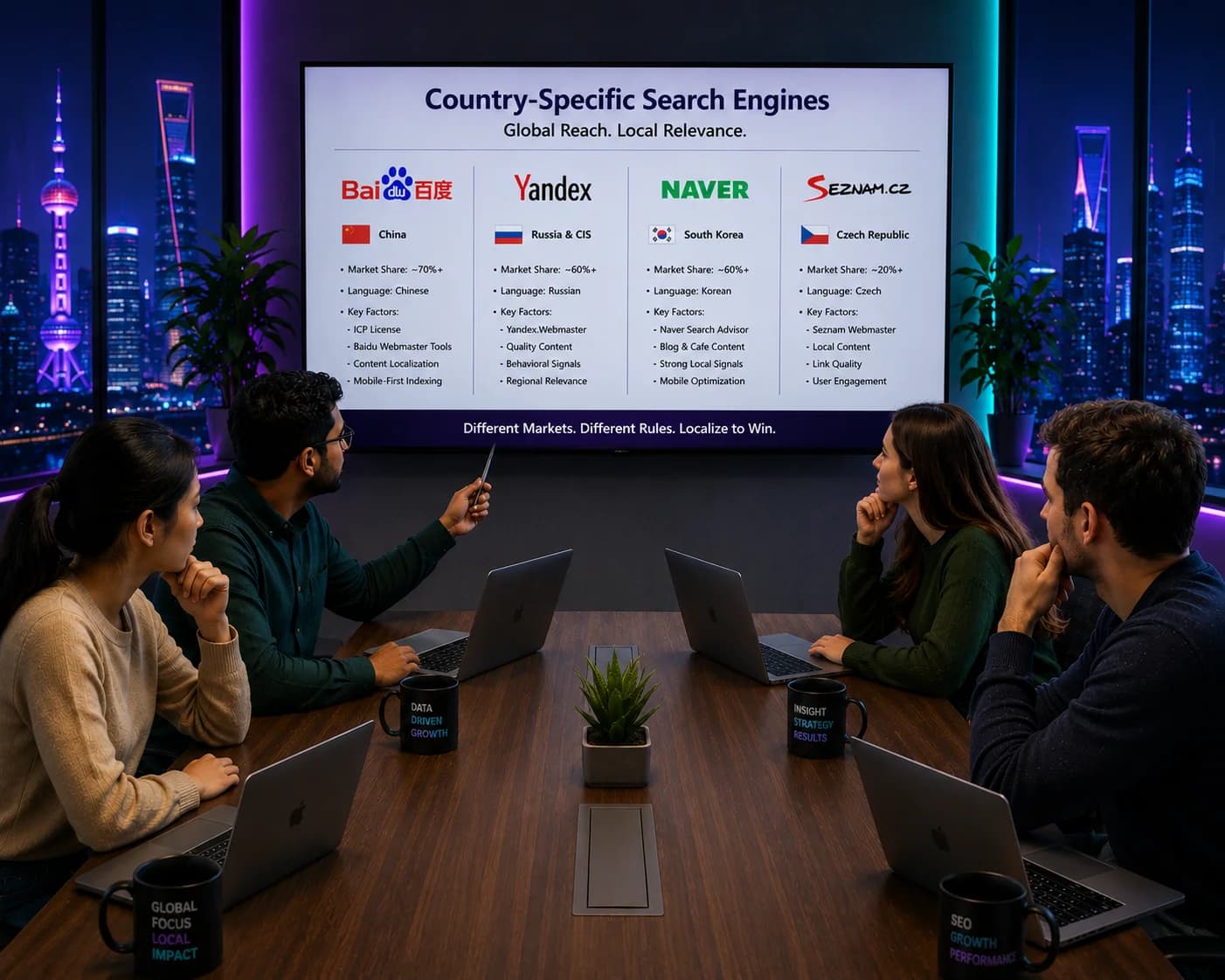
Most international SEO discussion implicitly assumes Google. In the markets covered by this chapter, that assumption breaks. China runs on Baidu; Russia on Yandex; South Korea has Naver as a dominant content-discovery engine; Czechia retains Seznam as a Google competitor; Japan blends Yahoo Japan and Google. Optimizing for these markets requires understanding what each engine prefers and where the standard SEO stack maps cleanly versus where it doesn't. This chapter is the survey — the specific tactics for each engine fill books on their own.
“Most international SEO programs that fail in non-Google markets fail because they translated their Google playbook instead of reading the local engine's documentation. Each of the major non-Google engines is a real engine with its own ranking logic — and the optimization that wins on Google can be neutral or counterproductive against a different engine.”
Baidu — China
Baidu commands ~70% of Chinese search traffic and operates in a regulatory environment that materially shapes the optimization stack:
- ICP licensing. Sites without an ICP license (a Chinese government registration tied to a Chinese business entity) can technically be indexed but rank at a structural disadvantage. ICP is the entry ticket to competitive ranking on Baidu.
- Local hosting preferred. Sites hosted within mainland China load faster (the Great Firewall slows external traffic) and signal local-business presence to Baidu. The hosting decision interacts with the ICP requirement.
- Simplified Chinese. Baidu serves mainland China; simplified Chinese is the language. Traditional Chinese targets Hong Kong and Taiwan, where Google is dominant.
- Baidu's own ecosystem. Baidu Baike (their Wikipedia-equivalent), Baidu Tieba (forums), Baidu Zhidao (Q&A) carry weight in their own engine's results. A brand without presence in Baidu's ecosystem is invisible to a meaningful share of queries.
- Reduced JavaScript rendering. Baidu's crawler historically struggled with JS-rendered content; server-side rendering or static HTML is the safer bet.
Yandex — Russia and Russophone markets
Yandex is the dominant engine in Russia and several CIS countries. The optimization stack:
- Yandex Webmaster Tools. The Yandex equivalent of Search Console. Site verification, indexing controls, and search-performance data live here.
- Yandex.Direct. Russian-market paid search. Optimization knowledge of Yandex.Direct also informs organic Yandex SEO because the engine surfaces overlap.
- Cyrillic content + .ru TLD. Native Russian content on .ru domains carries the strongest signal. Translation to Russian on a non-.ru domain is a weaker signal.
- Local hosting (sometimes). Yandex doesn't strictly require local hosting but it factors into geotargeting, especially for region-specific queries.
- Yandex's quality filters. Yandex has its own quality-evaluation framework distinct from Google's; thin content gets filtered more aggressively in some categories.
- The broader Yandex product ecosystem. Yandex Maps for local listings, Yandex Market for product visibility, Yandex.Zen for content discovery. Each is a separate optimization surface within the Yandex world.
Naver — South Korea
Naver is unusual: it's not a traditional search engine in the Google sense, it's a content portal that includes a search engine. The Korean user experience defaults to Naver for most discovery activities:
- In-platform content dominates. Naver Blog, Naver Cafe (community forums), Naver Knowledge In (Q&A), Naver Shopping all surface above general web results for many query types. Brands without presence in Naver's own platforms underperform regardless of standard SEO.
- Naver Smart Editor formats. Naver's content formats reward specific layouts (image-heavy, blog-style, structured data) that don't map cleanly to standard HTML.
- Korean keyword research. Naver has its own keyword tools (Naver Ad Center, Naver Trends) that surface different volumes than Google Keyword Planner for the same terms.
- The Naver Webmaster Tools. Korean equivalent of Search Console for sites that want web-search visibility.
- Mobile-first, mobile-extreme. Korean users are extremely mobile-heavy; Naver's mobile UX is prioritized in ways Google's isn't.
Seznam — Czech Republic
Seznam holds meaningful share in the Czech market, though Google has been gaining ground. The optimization stack is closer to Google's than Baidu's or Yandex's:
- Seznam's crawler reads the same web; technical SEO transfers cleanly.
- Czech-language content on .cz domains carries the strongest signal.
- Seznam's own portal services (Seznam.cz mail, Seznam Mapy) are the local equivalents of Yandex's portal pattern.
- The market is small enough that mid-sized brands often skip Seznam-specific optimization and rely on the overlap with Google rankings.
Yahoo Japan — special case
Yahoo Japan is a portal that uses Google's search index for web search but layers its own content and ads on top. Implications:
- Web-search optimization for Yahoo Japan is the same as for Google's Japanese index — the technical and content signals are shared.
- Yahoo Japan's own portal surfaces (Yahoo Japan Shopping, Yahoo Japan News, Yahoo Japan Auctions) are separate properties requiring their own optimization.
- The user behavior differs from Google.com.jp users — Yahoo Japan users tend to be older and more portal-oriented.
The "should I invest" decision framework
For each non-Google engine, three questions decide whether to invest:
- Do you actually serve that market? If you have customers, partners, or revenue in China, Russia, South Korea, Czechia, or Japan, the answer leans yes. If the market is purely aspirational, the per-market investment usually doesn't pay back.
- Can you operate the per-engine requirements? Baidu needs ICP licensing. Yandex benefits from Cyrillic content and Russian-market hosting. Naver requires in-platform presence. Without the operational footprint, the SEO investment runs into structural ceilings.
- Is the market large enough to justify a dedicated program? Mid-sized brands typically prioritize: Baidu only if China is a meaningful revenue market (massive operational lift), Yandex if Russia is on the roadmap, Naver if Korea is a strategic market, Seznam usually skipped.
The pragmatic priorities
For a multinational brand running an SEO program across non-Google markets, the realistic priority stack:
- Tier 1 (always invest): Google in non-Google-dominant markets where Google still has 20%+ share (Yandex's secondary share in Eastern Europe, Naver's secondary share in Korea). Cheap because the Google work transfers.
- Tier 2 (invest if the market is strategic): Naver for Korea (high return for investment when Korea matters), Yandex for Russia/CIS (specialist work but well-documented), Yahoo Japan portal surfaces (low effort given Google index sharing).
- Tier 3 (invest only with strong operational case): Baidu for China (highest cost, highest barrier, highest reward when justified). Often delayed until the brand has confirmed Chinese operations.
- Tier 4 (rarely justified): Seznam, niche regional engines. The market is usually too small to justify a separate program.
The shared technical floor
All non-Google engines share the technical-SEO baseline: indexable HTML, working canonicals, valid robots.txt, server-rendered content where the crawler is JS-light, structured data where supported. The chapter on crawling and indexing in the technical-SEO cluster covers the floor; per-engine specifics layer on top.
The next chapter, e-commerce SEO, moves into the specialized verticals — starting with e-commerce, where the standard SEO playbook has to be modified for catalog scale, faceted navigation, and out-of-stock dynamics.
Common questions
Common questions
Quick answers to what we get asked before every trial signup.
Five major markets. China — Baidu dominates with ~70% share; Google is blocked. Russia — Yandex holds majority share. South Korea — Naver is dominant in local search and content discovery despite Google's web-search share. Czech Republic — Seznam is competitive with Google. Japan — Yahoo Japan still has meaningful share, though it's powered by Google's index. Outside these five, Google is dominant in nearly every other market.
In this cluster