
AI SEO
Chapter 01 / 08
How AI engines rank
Retrieval, embeddings, grounding, and citation logic — the four mechanics that decide whether a passage of your content ends up in an AI answer or never gets read at all.
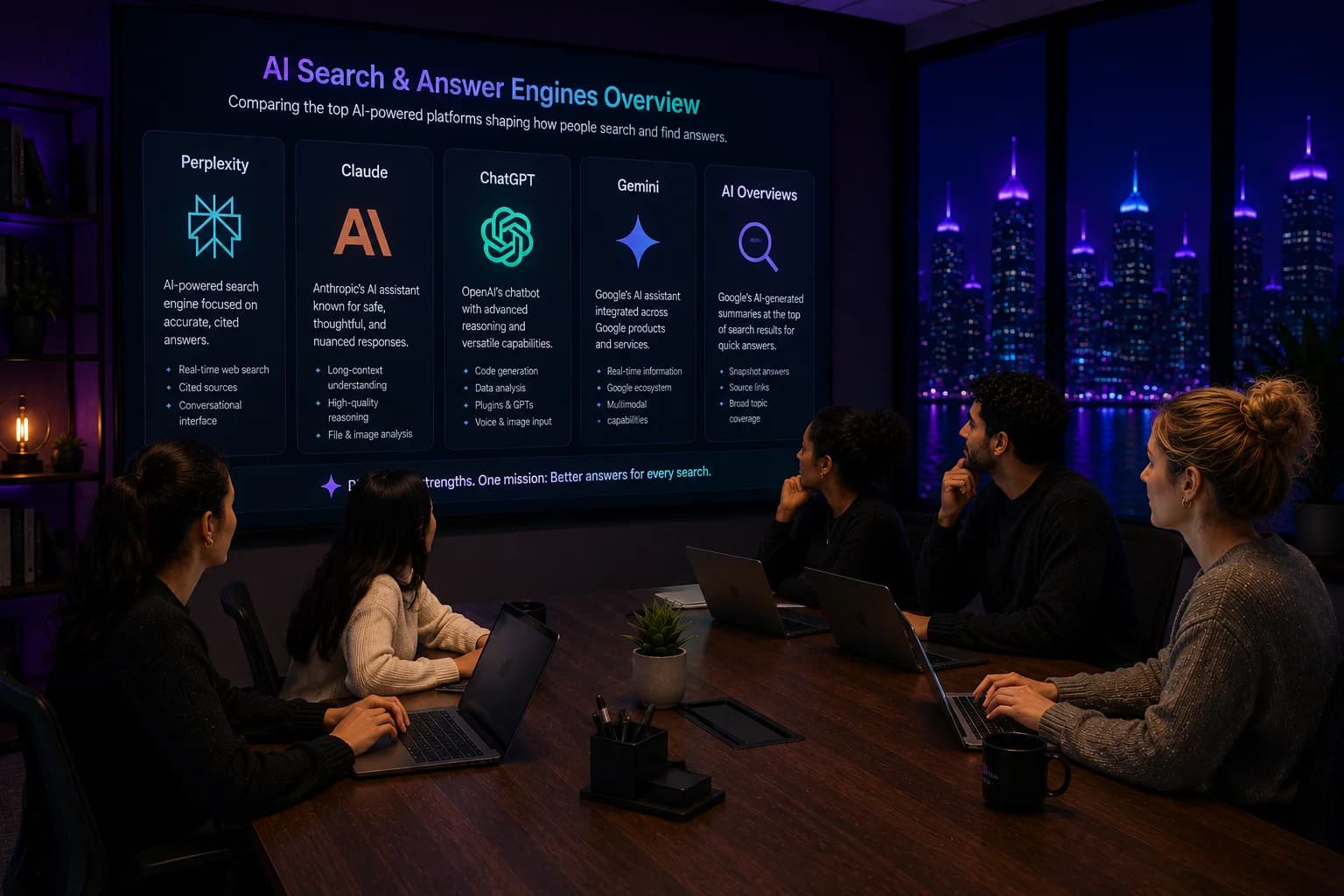
AI engines don't rank URLs the way Google ranks URLs. They retrieve passages, evaluate them against the user's query, and either cite a source or generate an answer without one. Optimizing for them requires understanding the four mechanics underneath every public-web AI engine in 2026: retrieval, embeddings, grounding, and citation logic. Once those four are clear, the engine-specific chapters that follow this one make sense as variations on the same model rather than four entirely different problems.
“Classical SEO ranks URLs against a query. AI SEO retrieves passages, weighs them against entity signals, and cites the ones that survive the grounding check. The unit of optimization moved from the page to the passage — and most of the optimization work nobody is doing yet happens at that level.”
Mechanic 1 — Retrieval
Retrieval is the step where the engine decides which documents to even consider for the answer. Two retrieval models matter:
- Lexical retrieval. Classical inverted index, BM25-style ranking. Matches exact terms in the query against the document. This is what Google's organic index is built on, with many layers added on top. Still used as a candidate-set filter even by AI engines.
- Embedding retrieval. The query is encoded as a vector; documents are pre-encoded as vectors; the top-k nearest-neighbor matches are returned. Semantic — matches passages that mean something similar to the query, even if no terms overlap. Dominant in AI engines and in the in-context retrieval that grounds answers.
Most AI engines in 2026 run hybrid retrieval — lexical to filter the candidate set, embedding to rank within it. The implication for optimization: pages need both the keywords (for lexical retrieval) and the semantic-content depth (for embedding retrieval) to make the candidate set in the first place.
Mechanic 2 — Embeddings
Embeddings are how AI models represent meaning numerically. A passage of text gets converted into a vector — typically 768 to 3,072 dimensions — that encodes its semantic content. Two passages with similar meanings produce similar vectors; two passages with different meanings produce different vectors. The retrieval index in an AI engine is built on these vectors.
Three implications for optimization:
- Topic depth matters. Embeddings reward content that goes deep into a single topic. A 2,000-word page that exhausts a topic produces a tighter, more retrievable embedding than a 2,000-word page that meanders across five topics.
- Question-answer pairs are recoverable. Engines often retrieve at the passage level (paragraph, FAQ entry, table row). Content structured as question-answer pairs — explicit FAQs, H2-question + body-answer patterns — is more retrievable than the same information embedded in flowing prose.
- Semantic clustering beats keyword stuffing. A page that discusses a topic using related concepts, synonyms, and adjacent terms produces a richer embedding than one that hammers the head keyword. Lexical SEO and embedding SEO point in the same direction once embeddings are involved.
Mechanic 3 — Grounding
Grounding is the constraint that the answer be verifiable against retrieved sources. Engines vary in how strictly they enforce this:
- Strict grounding (Perplexity, AI Overviews). The answer must be supportable by retrieved passages, with citations attached. Hallucinations are aggressively suppressed.
- Hybrid grounding (Gemini, ChatGPT with browsing). Retrieved passages inform the answer but the model can also fall back on training knowledge, and citations are sometimes produced and sometimes not.
- Loose grounding (ChatGPT without browsing, Claude without tools). Training-data answer with no live retrieval. Citations are generated when the user asks for them but are post-hoc and sometimes confabulated.
The optimization implication: tightly-grounded engines reward sources that are easy to ground against — clear claims, dates, structured data, named entities. Loosely-grounded engines reward sources that are well-represented in training data — wide indexing, broad citation, established brand entities.
Mechanic 4 — Citation logic
Citation logic is the rule the engine uses to decide whether to attribute the answer to a source and which source to attribute. Four patterns dominate:
- Always-cite (Perplexity). Every answer attempts to cite specific URLs. Citations are first-class output.
- Inline-cite when grounded (AI Overviews). Citations attached to specific claims when retrieval found supporting passages; absent when the answer drew from general knowledge.
- Reference-cite (ChatGPT, Gemini, Claude with tools). Citations clustered at the end of the answer or inline at the user's request. Sometimes link out, sometimes name-only.
- Implicit-cite (any engine without retrieval). The answer mentions sources by name without linking. Brand mentions in this mode still produce real awareness lift but no clickthrough.
How the five engines differ
Each of the next five chapters covers one engine in depth. The summary differences:
- ChatGPT: Hybrid retrieval (training + browsing). Strong preference for well-known sources, news, and product documentation. Citation pattern leans implicit unless asked.
- Gemini: Heavy live retrieval grounded in Google's index. Closest to organic SEO behavior; the engines whose results you can most directly forecast from organic ranking.
- Claude: Conservative source weighting. Strong preference for documentation, primary sources, and well-cited authorities. Browsing optional and produces explicit citations when used.
- Perplexity: Always-grounded, always-cited. Live retrieval against the open web with strict citation rules. The engine where new content surfaces fastest if it gets indexed and linked.
- AI Overviews: Google's own. Inherits Google's index and ranking signals, applies summarization and citation. Closest overlap with organic SEO but with passage-level retrieval characteristics.
The shared optimization stack
Despite the differences, every AI engine rewards the same underlying signals:
- Indexability + crawlability. If your page isn't in the public web index, no AI engine retrieves it. The technical layer is non-negotiable.
- Schema and structured data. Engines parse JSON-LD aggressively. Article, FAQPage, HowTo, Product, LocalBusiness, Organization — all read.
- Topic depth + passage structure. Long-form, deeply-treated topics with explicit Q&A structure get retrieved at higher rates.
- Entity signals. Brand, author, organization claims confirmed across schema, sameAs, Wikipedia, Wikidata, citation graph.
- Recency markers. Updated dates in schema, author bylines with credentials, last-modified headers — engines prefer recent and verifiable sources.
The engine-specific chapters layer engine-specific tactics on top of this shared stack. The next chapter, ChatGPT optimization, starts with the most-used AI engine in the world.
Common questions
Common questions
Quick answers to what we get asked before every trial signup.
Some do, some don't. Perplexity and Google AI Overviews run live web retrieval against the public index for every query. ChatGPT and Claude blend a static training cutoff with live retrieval triggered by specific tools (browsing, search, file lookup). Gemini sits between — heavy live retrieval grounded by Google's index, plus a strong training base. The implication: optimizing for AI engines is not just optimizing the training data, it's optimizing the live retrieval surface, which is the public index your URL is in right now.
In this cluster