







Pachuca 2
Col Condesa
CDMX
For over a decade, businesses have been obsessed with one question: "How do we rank on Google?" It’s a valid obsession. But a quiet, seismic shift has occurred right under our noses, and most businesses are completely missing it.
The inconvenient truth is this: when your customers want to learn how to do something, see a product in action, or understand a complex topic, they are increasingly bypassing Google and going straight to YouTube.
YouTube is no longer just a video-sharing site; it's the second-largest search engine on the planet, with over 2 billion logged-in monthly users. It’s a behemoth of engagement where your customers are actively searching for solutions. Failing to optimise for YouTube is no longer an option; it's a strategic blunder that hands your most engaged and valuable customers directly to your competitors.
At SEOTopSecret, our expertise isn't confined to traditional search. We dominate any platform where user intent can be captured. We understand that YouTube SEO isn't about chasing viral hits; it's a science of relevance, engagement, and authority.
This is not another superficial list of "hacks." This is a strategic guide. We will deconstruct how the YouTube algorithm works and give you a comprehensive, actionable playbook to optimise your videos and your channel. By the end, you'll see YouTube not as a social media channel, but as a powerful search engine you can systematically conquer.
YouTube SEO Algorithm
To win the game, you first need to understand the rules. The YouTube algorithm, much like Google's, has one primary goal: to keep users on the platform for as long as possible by serving them the most satisfying content. It uses a range of factors to determine which videos to rank.
While there are hundreds of signals, they can be boiled down to four critical pillars:
1. Watch Time:
This is the total cumulative time users have spent watching your video. It’s one of the most powerful signals of quality. A video that users watch for longer is seen as more valuable and is therefore promoted more aggressively by the algorithm.
2. Audience Retention:
This metric measures the percentage of your video that viewers watch. A video where viewers, on average, watch 70% of the way through is far more powerful than a video where they drop off after the first 30 seconds. A high audience retention signals to YouTube that your content is compelling from start to finish.
3. User Engagement Signals:
These are the active "votes" your video receives from viewers. They include:
- Likes and Comments: Direct indicators that your content sparked a reaction.
- Shares: A powerful signal that your content was valuable enough for a viewer to recommend to others.
- Subscribes: The ultimate vote of confidence—a viewer enjoyed your content so much they want to see more.
4. Keyword Relevance:
This is where traditional SEO principles come into play. The keywords you use in your video's title, description, and tags provide the crucial context that allows YouTube's algorithm to understand what your video is about and who it's for.
Strategic Keyword Research for YouTube
Just like with Google, you can't succeed without understanding what your audience is searching for. The goal is to find high-demand, low-competition topics that align with your business goals.
- Use YouTube's Autocomplete Feature: This is your starting point. Go to the YouTube search bar and type in a broad topic related to your industry (e.g., "small business marketing"). The autocomplete suggestions that appear are the most popular queries related to that topic. This is a direct insight into the minds of your audience.
- Analyse Your Competitors' Winning Videos: Identify the top 3-5 competitors in your niche on YouTube. Go to their channel, sort their videos by "Most Popular," and analyse the patterns. What topics are consistently getting the most views? What keywords are they using in their titles? Success leaves clues.
- Leverage Specialised Tools: While Google Keyword Planner is for Google search, specialised tools like VidIQ and TubeBuddy are designed specifically for YouTube. They can provide data on search volume, competition, and suggest related keywords directly within the YouTube interface.
On-Page SEO for YouTube Videos
Once you have your target keyword and topic, you need to optimise your video to send the strongest possible signals of relevance to the algorithm.
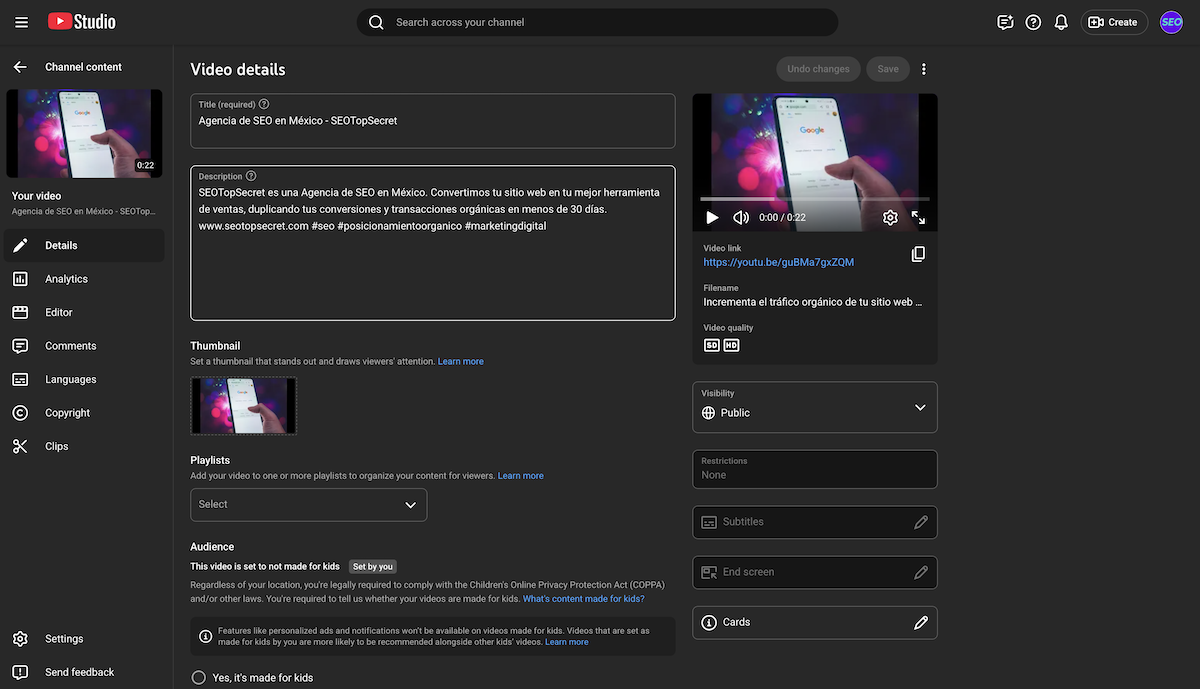
- The Video Title is Your #1 Weapon: Your title must be both compelling for humans and perfectly optimised for search. A winning formula is: [Main Keyword] | [Benefit/Intriguing Hook]. For example: How to Curl Hair With a Wand | Beginner's Guide for Flawless Curls. The first 70 characters are the most important, as they are less likely to be cut off.
- Craft a Value-Driven Description: Your video description is a huge opportunity. The first 2-3 lines are the most important, as they appear in search results.
- Start with a Strong Hook: Summarise the video's value and naturally include your main keyword.
- Provide a Detailed Summary: Write a 200-300 word description that expands on the topic, using related secondary keywords.
- Add Strategic Links: Link back to relevant products, services, or blog posts on your website.
- Include a Call-to-Action (CTA): End with a clear CTA to "Subscribe" and "Leave a comment."
- Use Tags Strategically, Not Excessively: Tags help the algorithm further categorise your video.
- Your first tag should be your main target keyword.
- Use a mix of broad keywords (e.g., "digital marketing") and specific, long-tail keywords (e.g., "local seo tips for cafes").
- Aim for 5-10 highly relevant tags. Overloading with irrelevant tags can be seen as spam.
- Say Your Keyword in the Video: YouTube automatically transcribes your video. Mentioning your target keyword verbally, especially in the first 15 seconds, is a powerful, often overlooked relevance signal.
The Conversion Machine: Your Thumbnail
Your thumbnail is your video's shopfront. It has one job: to stand out in a sea of options and earn the click. In YouTube search, a high Click-Through Rate (CTR) is a massive ranking signal. If people are clicking your video more than others, YouTube will rank it higher.
Thumbnail Best Practices:
- Clear, High-Contrast Images: Use bright, bold colours and a clear, high-quality image of a face or the end result.
- Minimal, Bold Text: Include 3-5 words of large, easy-to-read text that complements your title and sparks curiosity.
- Stay On-Brand: Use consistent colours, fonts, and logo placement to build brand recognition over time.
- Design for Mobile-First: Most users will see your thumbnail on a small screen. Ensure it is visually clear and impactful even when tiny.
- A/B Test Your Thumbnails: Use tools like TubeBuddy to test different thumbnail designs and see which one drives a higher CTR.
YouTube Channel Optimisation
Your channel homepage is the "homepage" of your brand on YouTube. It needs to be optimised to turn a casual viewer into a loyal subscriber.
- Create a Compelling Channel Banner: Your banner should visually communicate what your channel is about and who it's for.
- Select a High-Impact Channel Trailer: Your trailer should be a short, energetic summary (30-60 seconds) that hooks new visitors and clearly explains the value of subscribing.
- Organise with Playlists: Group your videos into logical playlists based on topic. This encourages binge-watching, which massively increases your channel's total Watch Time. It also helps YouTube understand the core themes of your channel.
- Write a Keyword-Rich "About" Section: Your channel's "About" page is indexable by both YouTube and Google. Write a detailed description of your channel, naturally including your main industry keywords.
YouTube is a Search Engine. Treat it Like One.
The brands that will win on YouTube in 2026 and beyond are not the ones who get lucky with a single viral video. They are the ones who understand that YouTube is a search engine and apply a disciplined, strategic SEO methodology to their content.
By focusing on user intent, creating genuinely valuable content, and meticulously optimising every element of your videos and channel, you can build a powerful, sustainable engine for attracting, engaging, and converting your ideal customers.
At SEOTopSecret, we see YouTube not as a separate entity, but as a crucial part of an integrated digital marketing strategy. It’s where your customers are looking for answers, and where your brand needs to be.
