
Content SEO
Chapter 04 / 07
E-E-A-T
Experience, Expertise, Authoritativeness, Trustworthiness — what each signal actually means in 2026, where Google reads them from, and the on-page changes that move the needle.
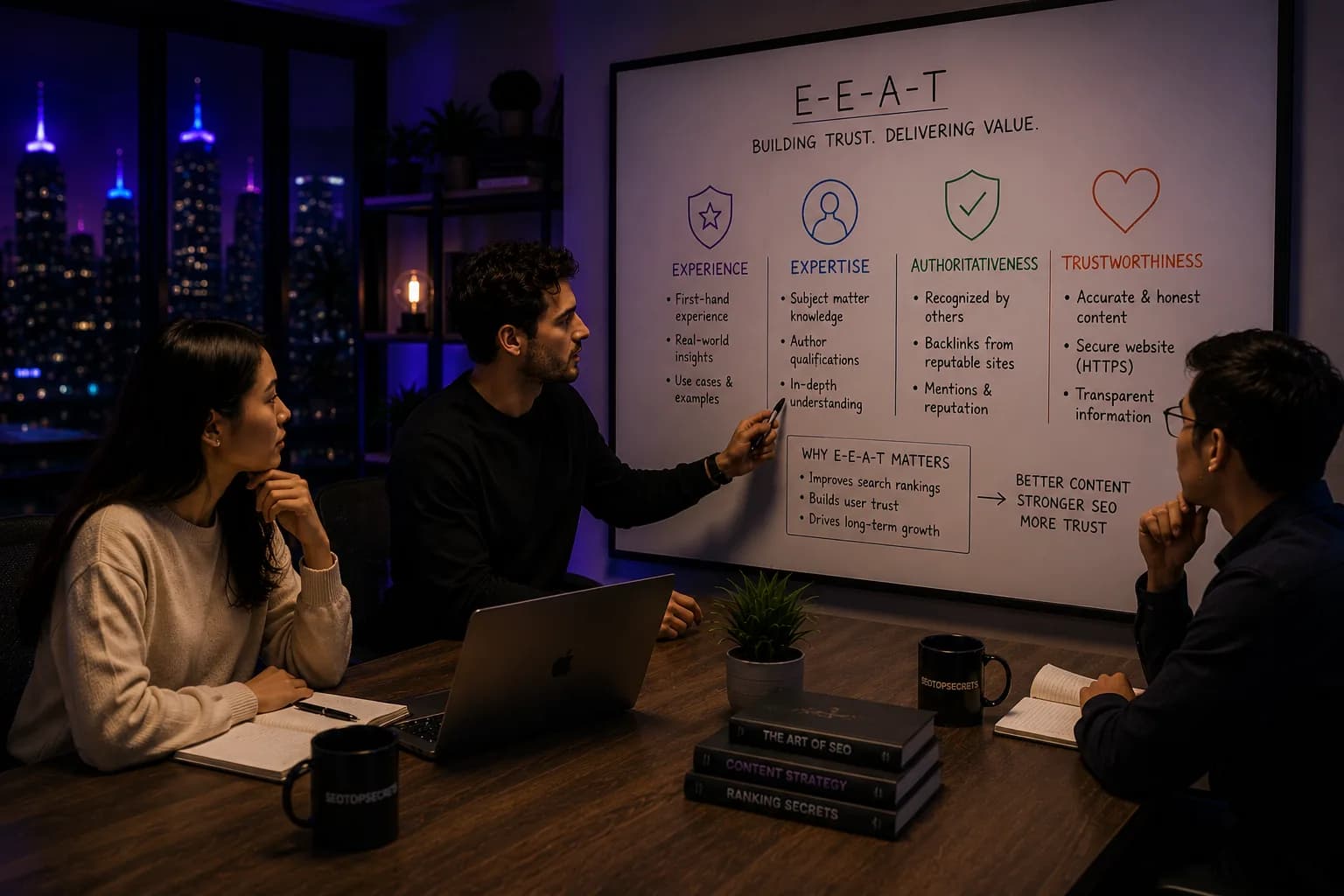
E-E-A-T is the framework Google uses to describe what makes content trustworthy enough to rank — particularly on YMYL (Your Money or Your Life) topics where bad information can do real damage. It’s not a literal ranking score, but it’s a useful map of the signals Google’s algorithms try to identify when deciding whether to surface a page.
“E-E-A-T isn’t a checkbox you can tick — it’s a coherent set of signals that, in combination, demonstrate the page is from a real expert who knows the topic and won’t mislead the reader. Sites that signal all four signals strongly outperform sites that excel on one and ignore the others.”
The four signals
| Signal | What it means | How to demonstrate |
|---|---|---|
| Experience | First-hand involvement with the topic | Original photos, original data, personal testing, specific observations from doing the thing |
| Expertise | Genuine knowledge of the subject | Author bios with credentials, depth of analysis, accurate technical detail, named expert authorship |
| Authoritativeness | Recognition by others in the field | Citations from other authoritative sites, mentions in the press, awards, speaking engagements |
| Trustworthiness | Honest, accurate, transparent operation | Transparent business info, clear authorship, citations to sources, factual accuracy, no misleading claims |
Experience — the newest signal
Experience was added in December 2022 to address the pattern of generic content (often AI-generated, but not always) that demonstrated theoretical knowledge of a topic without any sign the author had actually done the thing.
What signals experience:
- Original photos and screenshots — not stock images, not screenshots from the official site. Photos of the product you tested, screenshots from your actual workflow.
- Specific observations only someone who did the thing would notice. “The button is hard to find on mobile” vs “the UI is intuitive”.
- Original data — your own test results, your own benchmarks, your own customer outcomes.
- Process artefacts — your actual setup, your actual reports, your actual configuration. Real artefacts beat hypothetical examples.
- Time markers — “I tested this in March 2026 with version 4.2”. Specifics signal real experience; vague timeframes signal absence.
Expertise — the credentials signal
Expertise is what the author actually knows about the topic. Google evaluates this through:
- Named authorship with author bio pages.
- Credentials — degrees, certifications, years in field, named roles at recognised organisations.
- Depth of analysis — does the content go beyond surface-level explanation?
- Technical accuracy — is the detail correct? Subject-matter experts catch errors that signal absence of expertise.
- External recognition — has the author been quoted in other publications? Spoken at events? Written elsewhere?
For YMYL content (medical, financial, legal), credentials matter substantially more than for non-YMYL. A medical article by an unnamed author rarely ranks; the same article by a board-certified physician with a verifiable background does.
Authoritativeness — recognition by others
Authoritativeness is what others say about you. Self-claims of expertise mean nothing without external validation. Signals:
- Backlinks from authoritative sites in your field.
- Brand mentions across the web — even unlinked. AI engines particularly value co-occurrence of your brand with topical entities.
- Citations of your work — your data referenced by others, your articles mentioned in industry publications.
- Wikipedia mentions for the brand or named experts.
- Press coverage — articles in trade publications, mainstream media coverage of your work.
- Speaking engagements at industry conferences signal external recognition of expertise.
- Awards, certifications, partnerships with recognised organisations.
Trustworthiness — the foundation under everything
Trustworthiness is the most important of the four — Google’s own documentation calls it the centre of E-E-A-T. The other three signals don’t matter if the site can’t be trusted. Signals:
- Transparent business information — real address, real contact info, real team members on the About page.
- Clear authorship on every article with bio links.
- Citations to sources for factual claims, especially data and statistics.
- Factual accuracy — Google penalises content with verifiably false claims.
- Honest disclosures — affiliate relationships disclosed, sponsored content marked, conflicts of interest declared.
- Privacy and security — HTTPS, clear privacy policy, secure handling of user data.
- Reasonable claims — “guaranteed results” and “cure-all” claims signal untrustworthy operation.
- Reviews and reputation — what others say about the brand on third-party sites.
Where Google reads E-E-A-T from
- The page itself — author byline, content depth, citations, original data, clear claims.
- Author profile / bio pages — credentials, employer, background, sameAs links to LinkedIn / Twitter / external publications.
- About page — business identity, team, contact details, history, mission.
- External signals — backlinks from authoritative sites, brand mentions, press coverage, third-party reviews.
- Schema markup — Person schema with credentials, Organization schema with sameAs, Article schema with author.
- Wikipedia, Wikidata, Crunchbase, LinkedIn presence — signals of real-world recognition.
YMYL — where E-E-A-T weighs heaviest
Your Money or Your Life topics are content that could substantively affect health, finances, safety, or major life decisions. Examples:
- Medical and health advice.
- Financial guidance — investing, taxes, loans, insurance.
- Legal information — rights, regulations, consumer law.
- News about civic processes, elections, voting.
- Safety information — dangerous activities, emergency response.
On YMYL topics Google holds content to a substantially higher E-E-A-T standard. A YMYL site without strong author credentials, transparent business info, and external authority signals struggles to rank no matter how good the content is. The investment in author bios, organisational structure, and external recognition is non-optional for YMYL operators.
How to systematically improve E-E-A-T
- 1. Add named authorship to every article with bio page, credentials, photo, sameAs links to LinkedIn and external publications.
- 2. Build author profile pages with Person schema, full credentials, list of articles, external links.
- 3. Strengthen the About page — business address, team, history, mission, real contact information.
- 4. Cite sources for every factual claim, especially statistics. Link to primary sources where possible.
- 5. Add original data — your own research, customer surveys, benchmark studies, case studies with metrics.
- 6. Pursue external mentions — guest posts on authoritative sites, press coverage, podcast guesting, conference speaking.
- 7. Demonstrate experience in content — original photos, screenshots from your workflow, specific observations, time markers.
- 8. Review and remove untrustworthy content — overpromising claims, outdated stats, broken references, content with no clear ownership.
- 9. Implement schema — Person, Organization, Article with author, Article with sameAs.
- 10. Monitor third-party reputation — reviews, Trustpilot, BBB, industry-specific reputation surfaces.
Common E-E-A-T mistakes
- Anonymous or pseudonymous authorship. Articles bylined “Editorial Team” signal absence of expertise.
- Generic stock photos pretending to be experience. The same business-team-laughing-around-laptop image fools nobody.
- Self-claims without external validation. “Industry leader” means nothing if no third party says so.
- Citations to other content marketing instead of primary sources. Daisy-chains of marketing blogs citing each other don’t establish authority.
- YMYL content without credentials. Medical/financial/legal content from anonymous authors fails the E-E-A-T floor.
- Affiliate content without disclosure. Hides the relationship, fails trustworthiness, gets demoted.
- Outdated content that hasn’t been refreshed. Stale information signals carelessness about accuracy.
The bottom line
E-E-A-T is the lens for understanding what Google’s algorithms try to reward: real experience, real expertise, real recognition, real trustworthiness. It’s not a literal ranking score, but the signals that map to E-E-A-T move rankings substantially — particularly on YMYL topics where Google holds content to a higher standard. Systematically build all four (named authorship, demonstrable experience, external authority signals, transparent operation) and content compounds; ignore any one and the ceiling on ranking gets noticeably lower.
Common questions
Common questions
Quick answers to what we get asked before every trial signup.
Experience, Expertise, Authoritativeness, Trustworthiness. Google added the second 'E' (Experience) in December 2022. The framework is from Google's Quality Rater Guidelines — the document Google's human raters use to evaluate search quality. Quality raters don't directly affect rankings, but their judgments train the algorithms that do. E-E-A-T isn't a direct ranking signal but a useful framework for understanding what Google is trying to reward.